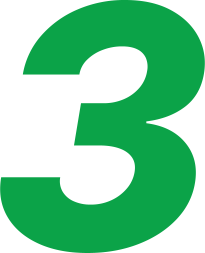
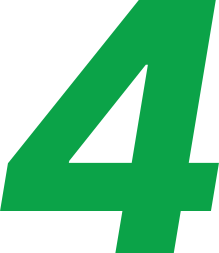
The Open class in sheepdog trials is truly "open" in all senses of the word: any dog, regardless of breed or registration credentials, and any handler, regardless of qualifications or experience, is permitted to pay an entry fee and step up to the post. The National Finals, however, is limited to those dog/handler teams who have done well enough at Open trials throughout the year to qualify for the event. In practice, this means that all of the dogs you will see have themselves defeated a good number of dogs at several different trials. The first three days of the Finals are the preliminary rounds, in which these 150 or so top teams will be narrowed down to 40. From those 40, the semi-final round on Saturday will determine the 17 teams who will compete for the ultimate Championship on Sunday. The preliminary and semi-final rounds will both have a time limit for each contestant, and the course will be as follows:
The course begins with the
Outrun (20 points). The handler will send the dog (according to his or her choice) either clockwise or counterclockwise. The dog must cast out in a deep, pear-shaped arc (without additional commands) that will end when the dog is directly behind the sheep. Dogs who arrive too close to the sheep may upset them; dogs who travel in too wide a path will not reach the sheep quickly and efficiently. Dogs who turn onto their sheep before getting behind them ("coming up short") or who overshoot them ("overrunning") will have points docked from their outrun scores. Dogs who stop or who need to be stopped during the course of the outrun will be strongly penalized. Dogs who "cross over" between the handler and the sheep will often lose as many as 19 points.
The
Lift (10 points) is the critical point at which the dog and sheep meet and assess one another. The sheep should start down the field in a straight, orderly fashion. It is at the lift that the dog and sheep begin a relationship that will be maintained throughout the remainder of the run. Dogs that push too hard will cause the sheep to be wild and unsettled; dogs that are too tactful may have trouble convincing their sheep to march along the course. If the dog has been kind but authoritative, the sheep will be respectful and orderly. Points will be deducted for too slow or too rough a lift, or for sheep moving in any direction other than straight to the
handler.
The
Fetch (20 points) begins immediately after the lift. It should be absolutely straight and should, like all phases of work in the trial, be efficient and workmanlike. The sheep should come right through the center of the fetch gates in the middle of the field and pass behind the handler at the post. Points will be deducted for a dog who "rings" his sheep (runs all the way around them on the fetch), or who pushes the sheep off the line, or whose sheep miss the fetch gates, or whose sheep turn the wrong way around the handler's post.
The
Drive (30 points) starts at the back of the handler's post. The sheep must go in a straight line to the first drive gates, make a sharp turn toward the second drive gates, and return in a straight line to the pen. The straighter the lines and the tighter the turns, the better the drive score will be. Points will be deducted for imprecise lines, missed panels, and (as on the fetch) for dogs who ring their sheep rather than remaining behind them.
The drive ends when the sheep are at the mouth of the
Pen (10 points). Ideally, the sheep should enter the pen without hesitation at the pen mouth. Points will be deducted for sheep that balk before going in, and more points will be deducted for sheep that circle the pen before going in (the more circles, the more points deducted).
After the pen, the dog and handler will take the sheep into a marked ring for the
Shed (10 points). The handler must line the sheep up in a row and call the dog through to turn on the last single. In the ideal shed, the sheep in front of the dog will feel able to escape, and the last sheep will feel unable to join them because of the authority of the dog. Proper sheds are taken on the head, with the dog face to face with the chosen sheep before turning her. Shed points will be deducted for too much of the work done by the handler and not enough by the dog, failed attempts, and sheep that leave the marked ring.
If you are interested in learning about the details of how the trial will be judged, you can read the
judging guidelines put out by the United States Border Collie Handlers Association.